MIT NEWS
"Phytoplankton are single-celled organisms that serve as the base of the
marine food web and provide half the oxygen we breathe on Earth. They
also play a key role in global climate change by removing carbon from
the atmosphere and injecting it deep into the oceans.
Scientists
study phytoplankton to understand how the tiny plants help transport
elements like carbon through the environment. Although they understand
much of what phytoplankton do, less is understood about why particular
plankton live in particular environments and what maintains the
diversity of phytoplankton.
Previous research has suggested
that more diverse ecosystems may be more efficient at utilizing
resources, meaning that the diversity of phytoplankton could be
important for regulating the cycles of carbon and other elements in the
ocean. But scientists need a better understanding of that diversity
before they can understand how much carbon the ocean ultimately removes
from the atmosphere.
In order
to grow, phytoplankton need sunlight and nutrients like carbon, some of
which comes from the carbon dioxide in the atmosphere. When
phytoplankton die, some of their cells sink to the ocean floor, taking
carbon away from the atmosphere and injecting it deep into the ocean
through a process known as the “biological pump.” To understand the
global scale of this process, scientists must learn more about the
diversity of phytoplankton species.
“We feel this paper is a
step toward understanding what the phytoplankton diversity is at
different places in the ocean and what regulates that diversity,” said
lead author Andrew D. Barton, a graduate student in the Department of
Earth, Atmospheric and Planetary Sciences (EAPS).
Although
future studies will have to make a more explicit link between
phytoplankton diversity and the climate, Barton hopes that his group’s
models could be used as a tool to inform future sampling surveys that
try to map phytoplankton diversity in the ocean" (mit news).
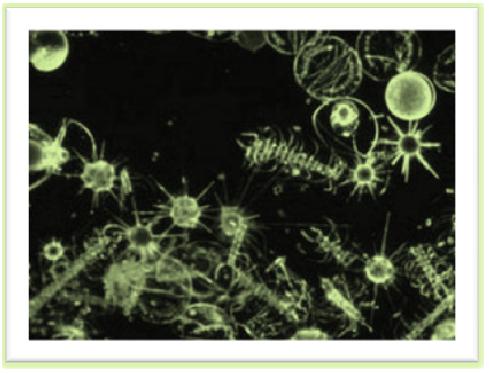
The picture below is the image of phytoplankton under a microscope. Taken from http://visindavefur.hi.is/.
KING 5 NEWS "SEATTLE -- A necropsy is scheduled Thursday on another grey whale that has died in the Puget Sound. It's the fourth grey whale to wash ashore this month. The whale was first spotted Wednesday just off the West Seattle shoreline. By Thursday afternoon, the dead whale had washed up along Arroyo Beach, which attracted considerable attention. Researchers will be out trying to answers many questions lingering on how the whale died. NOAA officials gave a rough estimate of the whale, saying it is about 30 feet long and appears to be underweight, but the sex is unknown at this time. West Seattle Blog reports the whale is female, sub adult and emaciated. KING 5 has also received new video around the time when the whale may have taken its last breath. Neighbors say they saw it breathing shortly before it stopped moving. Marine biologists say it's not unusual for five to seven whales to die in a migration season as they make their way north to their summer feeding grounds around Alaska, but more deaths would be cause for concern. The carcasses, including the one near West Seattle, have all been skinny. Experts say it could be an indication the whales aren't finding enough food in the ocean. Researchers are expected to come out today and remove the carcass to perform a whale autopsy or necropsy. This is the fourth dead gray whale to wash up in the Puget Sound area since April 4. A fifth whale washed up on Vancouver Island, west of Victoria. Another dead grey whale turned up on Samish Island and another near Deception Pass. Another was found in Oakland Bay in Mason County. The necropsy on the Samish Island whale wrapped up this week. Experts say it had a very little in its stomach and dried blubber, which indicates the whale was trying to survive on its own blubber. Biologists want to see if this is the same situation with this dead whale"(King 5 News).
"One of the neighbors thought they saw it gave its last breath, so to speak," said one West Seattle resident.